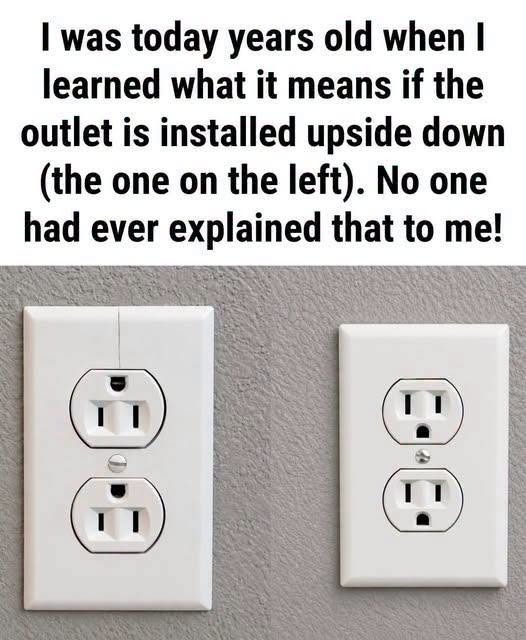
The orientation of a standard NEMA 5-15 wall outlet—specifically whether the ground pin sits at the top or bottom—is often assumed to be fixed. However, both ground-up and ground-down orientations are functional. Electricians select specific orientations based on environmental hazards, commercial specifications, and circuit identification.
🔌 Outlet Pin Functions & Orientation Mechanics
| Pin Type | Structural Design | Primary Function | Ground-Up Safety Advantage |
| Ground Pin | Round, longer pin | Connects directly to the building’s grounding system to safely redirect stray current. | Positioned on top, it acts as a physical shield against falling conductive objects. |
| Hot Slot | Shorter vertical slot | Delivers electrical current from the breaker panel to the appliance. | Shielded beneath the ground pin to minimize accidental contact when partially unplugged. |
| Neutral Slot | Wider vertical slot | Completes the electrical circuit back to the panel. | Protected alongside the hot slot under the physical barrier of the ground pin. |
🧪 Electrical Safety & Physical Dynamics
-
Mitigation of Conductive Bridging: If a plug is partially pulled from a wall socket, the energized hot and neutral metal prongs become exposed. If a conductive metal object—such as a picture frame, metal ruler, loose coin, or paper clip—falls into the gap:
-
In a ground-down outlet, the falling object contacts the hot and neutral prongs simultaneously, creating a direct short circuit, severe arcing, or a potential fire hazard.
-
In a ground-up outlet, the falling object strikes the extended, uninsulated ground pin first and is deflected safely away from the energized contacts underneath.
-
-
National Electrical Code (NEC) Compliance: The National Electrical Code (NEC) does not mandate a single vertical orientation for standard wall receptacles. Both ground-up and ground-down installations are code-compliant provided the wiring, box grounding, and polarity are correctly wired.
🏢 Why Ground-Up Outlets Are Used in Commercial & Healthcare Facilities
🏠 Why Ground-Down Remains Common in Residential Homes:
LOOK NEXT PAGE DEAR──►
For Complete Cooking STEPS Please Head On Over To Next Page Or Open button (>)